
What building a referral tracking app taught me about AI, vibe coding, and the future of small business systems.
I have a problem.
Whenever I encounter a slightly inefficient business process, my brain immediately starts trying to fix it.
So when I joined a referral roundtable through the Newport Beach Chamber of Commerce, it didn't take long before I started looking at the way we tracked our activity and thinking:
There has GOT to be a better way to do this.
So I built one.
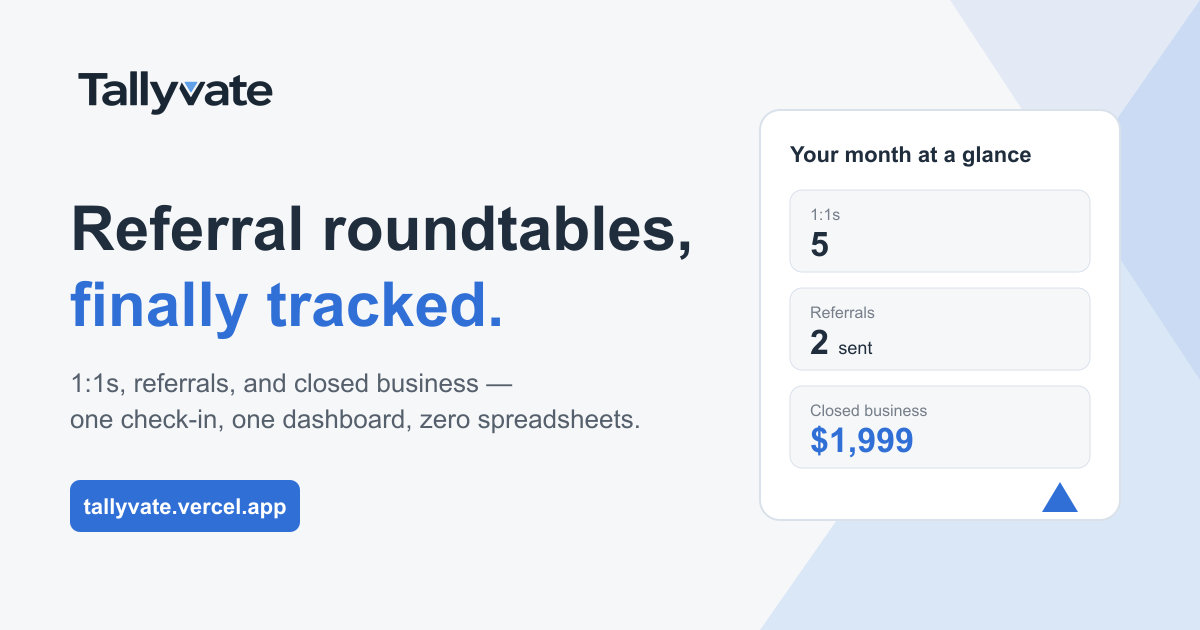
Meet Tallyvate: a small app I built specifically for our referral group.
And here's the slightly ridiculous part:
I'm not a developer.
The problem
Like a lot of referral and networking groups, we track activity.
Members pass referrals, they have 1:1 meetings, they bring visitors, business gets closed, and those numbers matter because they tell us about the health and engagement of the group.
But collecting the numbers is only one part of the problem. We also needed a way to give the group leadership a useful picture of what was actually happening. When I joined, it was a lot of manual work and spreadsheet-massaging, and I just didn't believe it needed to be that difficult.
Basic information was really tricky to get, like:
-
Who is engaged?
-
Where is activity slipping?
-
How many referrals are moving through the group?
-
What business is actually being generated?
And how do you collect all of that without creating an administrative nightmare? This is usually the point where a small organization reaches for a spreadsheet. And listen, I love a spreadsheet.
But I kept thinking about what the process could look like.
So I built Tallyvate
Tallyvate gives members a simple place to check in and submit their activity.
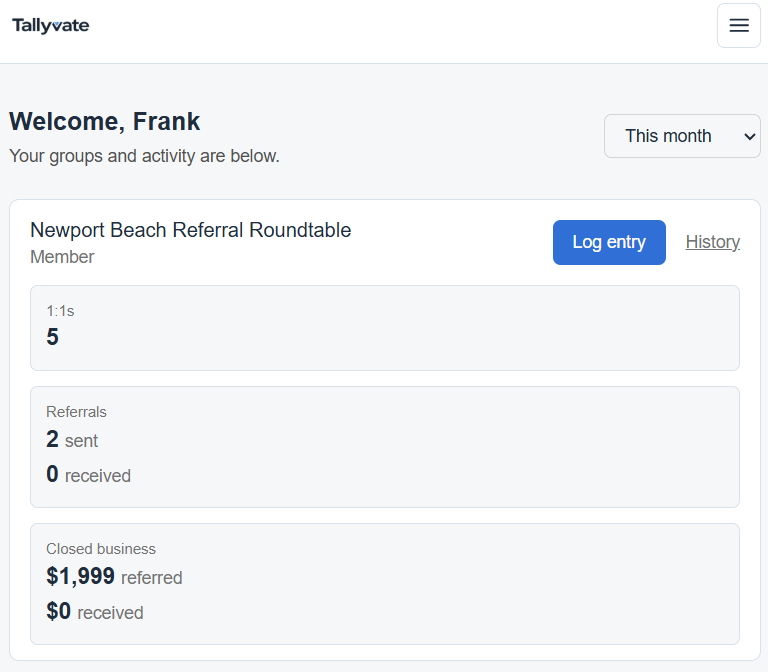
I wanted the member experience to be ridiculously simple. Nobody joins a networking group because they're passionate about data entry.
Members can quickly report things like referrals, 1:1s, visitors, and closed business:
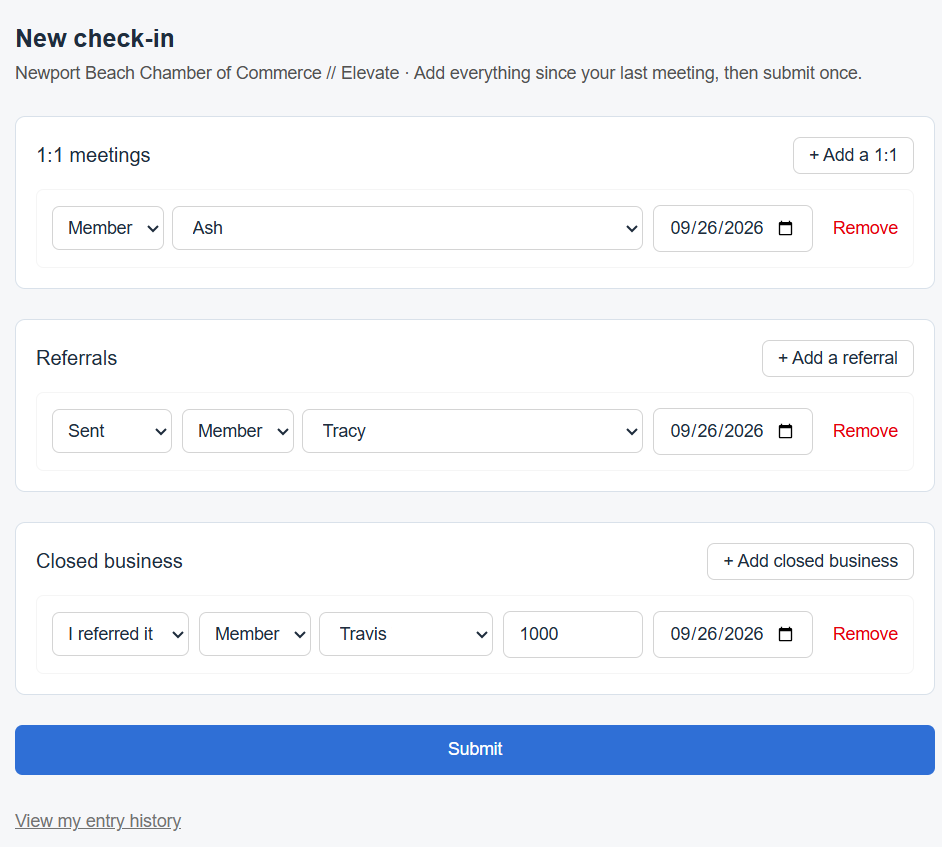
But collecting the data was only half the problem.
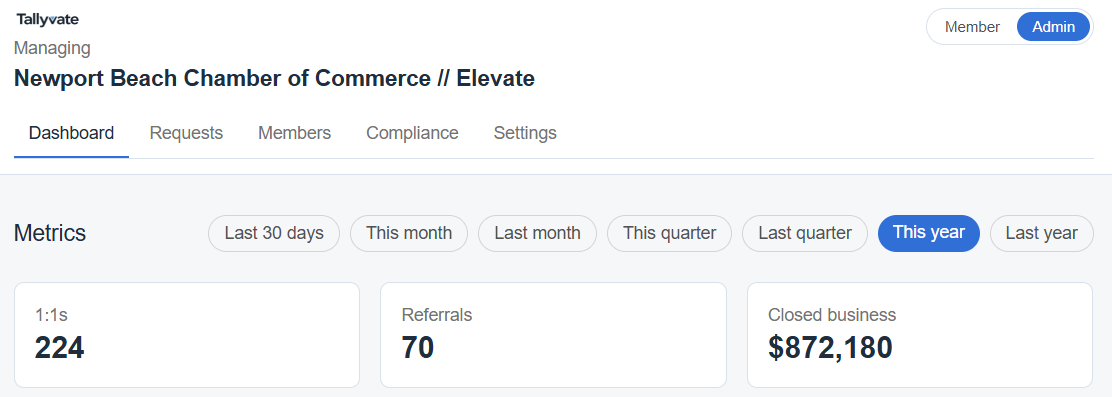
Leadership also needed to be able to actually do something with it.
Who's engaged? Where is activity slipping? How many referrals are moving through the group? What business is actually being generated?
So the other side of Tallyvate turns all of those individual check-ins into a clearer picture of how the group is doing.
I also built in things like AI-assisted duplicate detection, because "Bob Smith" and "Robert Smith" should probably not become two different people in your reporting just because someone entered the name differently.
My goal wasn't to build a giant piece of software, I knew this was essentially a glorified form.
I wanted to build the smallest useful system for my hyper-specific problem, and that's where this experiment got interesting.
Custom software used to be a ridiculous solution
Imagine pitching this a few years ago:
"We have a referral group and we'd like a custom application for tracking our activity."
Cool, who's paying the development team?
The problem simply was never big enough to justify traditional custom software development. So we adapted. We'd use a spreadsheets, or piece together existing tools. We'd do whatever we needed to do to accommodate whatever software was available.
Small businesses do this ALL THE TIME because building something better and hyper-specific to one group's needed is usually not economically realistic.
But now, AI-assisted development is starting to change that equation.
Enter: vibe-coding
Before Tallyvate, I had already started experimenting with Claude Code while rebuilding my website in HubSpot, and it made me realize something:
The gap between knowing what I want to build and being technically capable of building it is getting much smaller.
Listen, I still can't sit down and code Tallyvate from scratch. But I can map a process, I can define requirements, I can figure out what information needs to go where, I can decide what a user should have to enter and what the system should figure out automatically. I can identify edge cases, and test an output and realize something isn't behaving the way the business actually needs it to behave.
In other words: I understand systems. I've been trained on these skills for over a decade.
What's cool is that AI is now able to help with the part that most of us I couldn't do before: turning those requirements into working software.
Knowing what to build
This might be the biggest thing I've taken away from experimenting with AI-assisted development. There's a lot of excitement right now around how easy it is becoming to build things, and there should be. This is really freakin' cool.
But just because you can, doesn't mean you should. Easier building doesn't automatically create better systems.
You can automate a terrible process, or build an app nobody wants to use. You can add 47 features because you can and end up making everyone's job harder.
The important questions still come first:
-
What problem are we actually trying to solve?
-
What do my users need?
-
What should be automated? What shouldn't?
-
What information actually matters?
-
What happens when something doesn't follow the normal process?
Technology can help execute the answer, but somebody still has to understand the business well enough to ask the right questions.
Why this is awesome for small businesses
Small businesses are full of weird, specific processes, and I say that lovingly.
Small business have the spreadsheet that someone updates every Friday, and the form that gets copied into another system. They have those weird workaround the entire team knows, and the process that works perfectly except for those three very specific situations.
Historically, businesses have had to choose between adapting those processes to off-the-shelf software or spending a lot of money building something custom, but now, AI is creating a really interesting space in between.
While this isn't ALWAYS the case, there are going to be a LOT more situations where a small, purpose-built tool actually makes sense.
Tallyvate was my first real taste of that, and I have a feeling it won't be the last.
Your systems should fit your business
That's been the philosophy behind my work for a long time.
-
Understand the business.
-
Figure out what the technology should do about it.
Sometimes the answer is Salesforce, or HubSpot, or Zapier.
Sometimes it's a spreadsheet, and apparently, sometimes... you build the dang app yourself.
Have a weird little process in your business that makes you think, “There HAS to be a better way to do this”?
Tell me about it.
Let’s talk systems.